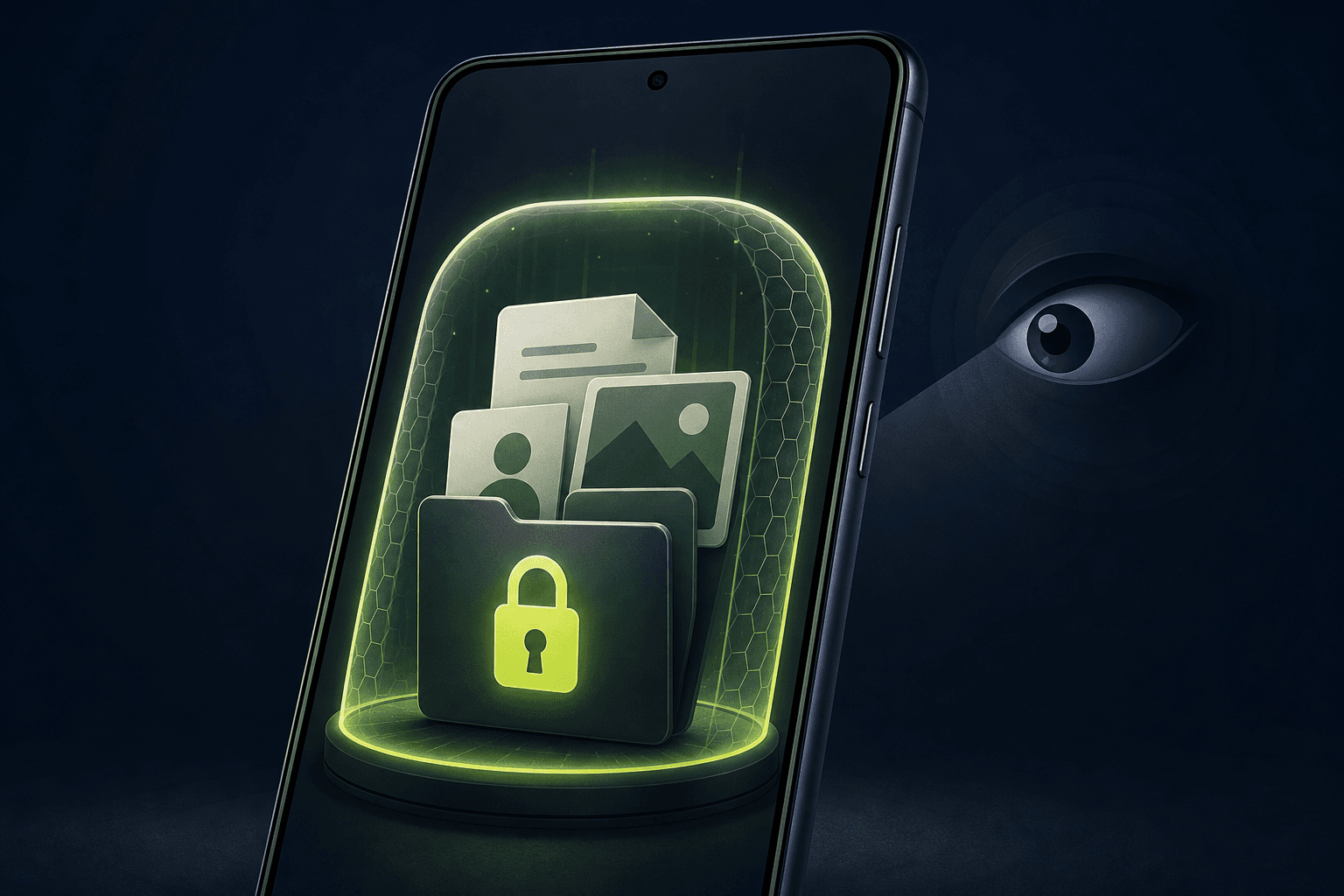
Secure Folder on Android is a Samsung feature that places selected apps and files in a separate, protected area on a compatible Galaxy phone. It can help keep personal photos, documents, accounts, and apps away from casual access—but it is not a universal invisibility cloak and it does not detect spyware.
Secure Folder normally requires its own lock method, such as a PIN, password, pattern, or biometric check. The exact name, availability, and settings path can vary by device model, Android version, and manufacturer. Other Android phones may offer a comparable private-storage feature, but you should not assume it works the same way as Samsung Secure Folder.
The most important distinction is this: private storage protects selected content from ordinary access on the phone; it does not guarantee protection from every form of device or account compromise.
What Secure Folder is#
Secure Folder is a protected container associated with Samsung’s device-security features. You can place supported apps and personal files inside it so they are separated from the regular phone environment.
For example, you might use it for:
- Private photos or scanned documents.
- Work files on a personal phone.
- A separate copy of a messaging or social-media app.
- Notes, downloads, or accounts you do not want visible in the normal app area.
The apps inside the folder are generally treated as separate installations or instances from their copies outside the folder. That means an app inside Secure Folder may require its own sign-in and may not automatically share data with the version outside it.
Secure Folder is primarily a privacy boundary. It is not the same thing as uninstalling an app, hiding an app icon, or checking whether an app has suspicious permissions.
What Secure Folder can protect#
When it is correctly locked, Secure Folder can reduce the risk of someone who briefly uses your unlocked phone opening the selected content. It can also keep selected apps and files out of the ordinary app area and gallery view.
It may be useful when:
- You share a phone temporarily with a family member, colleague, or repair technician.
- You want work and personal apps separated.
- You keep identity documents or sensitive images on the device.
- You want a second, separately signed-in copy of an app.
The protection depends on the strength and privacy of the folder’s lock. A long, unique password is usually harder to guess than a short PIN. If your phone is already unlocked when someone accesses it, the protection may be weaker if the folder is open or its contents are visible through another app.
For broader privacy checks, our guide to Android app permissions for location, camera, and microphone explains how to review what apps are allowed to access. Secure Folder does not replace that review.
How to set up Secure Folder safely#
Secure Folder is primarily a Samsung Galaxy feature, and it is not available on every Android phone. On a compatible Galaxy device, the most reliable way to find it is to open Settings and search for “Secure Folder.” The exact menu path and labels can vary by model, Android version, and One UI version. Other manufacturers may use different names and workflows for comparable private-storage or app-lock features.
A safer setup process is:
- Open Settings and search for “Secure Folder.” Confirm that the result belongs to the phone’s system settings rather than an unrelated third-party app.
- Create a separate lock. Avoid reusing a password that protects your email, banking account, or password manager.
- Choose whether biometric unlocking is appropriate. Biometrics can be convenient, but a password may be preferable in situations where you need a non-biometric lock option.
- Add only the apps and files you actually need. A folder is easier to manage when you know what it contains.
- Add or move files into the folder. Open Secure Folder and use the available option for adding, importing, or moving files, then select the photos or documents you want to protect. The wording and available choices can vary by Samsung model, One UI version, file type, and app. If you choose to copy rather than move a file, or if the source app retains the original, check ordinary storage afterward so you know whether another copy remains outside Secure Folder.
- Review notification behavior. Notifications from apps inside the folder may reveal an account name, message preview, or the fact that an app is active. Select a less revealing notification setting where available.
- Lock the folder when you finish using it. Do not assume that leaving the phone unlocked also leaves the folder protected.
Do not install an APK from an unknown website to obtain a similar feature. Use the phone’s built-in settings or the manufacturer’s official app and support channels.
Secure Folder is not the same as hiding an app#
Hiding an app usually changes whether its icon appears in the launcher or app list. It does not necessarily isolate the app’s data, stop its background activity, or protect its notifications.
Secure Folder is different because it is intended to separate selected apps and files behind an additional lock. However, the separation is not absolute in every situation. Shared files, notification previews, cloud accounts, screenshots, and other apps may still reveal information.
If your concern is that an app has been deliberately concealed, use our guide on how to find hidden apps on Android. That is a discovery task, while Secure Folder is a private-storage task.

Secure Folder versus permissions and spyware detection#
These tools address different problems:
| Tool or feature | Main purpose | What it does not establish |
|---|---|---|
| Secure Folder | Separates selected apps and files behind an additional lock | That the phone is free of spyware or account compromise |
| Hidden-app settings | Changes whether an app is easy to see in the launcher or app list | That hidden software is malicious or inactive |
| App permissions | Controls access to data such as location, camera, and microphone | That an app has never collected data through another permitted path |
| Security scanning | Looks for certain known or suspicious software patterns | That every form of surveillance or compromise has been found |
Battery drain, overheating, increased data use, or an unfamiliar app can have many ordinary explanations. None of those signs alone proves surveillance. If you see several concerning signs, review installed apps, permissions, account security, and device updates rather than relying on Secure Folder as a diagnostic tool.
Our Android spyware detection guide explains why no single scan can guarantee that a phone is safe and suggests proportionate next steps.
What may still be visible outside the folder#
Private storage can reduce casual access, but information may appear elsewhere. Check these areas when deciding whether Secure Folder meets your needs:
- Notifications: Message previews, sender names, or account names can appear on the lock screen or notification shade.
- Screenshots and screen recordings: A screenshot made outside the protected area may be saved in ordinary storage or backed up elsewhere.
- Shared files: Sending a photo or document to another app can create a copy outside Secure Folder.
- Cloud backups and synchronization: An app may sync data to an online account according to its own settings.
- Recent apps or usage indicators: Device interfaces may expose that an app has been used, even if they do not show its private content.
- Accounts: Signing into the same account in multiple app instances can connect activity across environments.
- Physical access: Someone with extended access to an unlocked phone may be able to observe notifications, copy information, or change settings.
The precise behavior can depend on the Samsung model, software version, app, account, and backup configuration. Treat the folder as one layer of protection, not a promise that no trace can appear anywhere.
When Secure Folder is not enough#
Use additional precautions if you are dealing with a lost phone, a compromised account, suspected spyware, or an abusive person who may monitor your device. Consider:
- Updating Android and installed apps.
- Reviewing unfamiliar apps and their permissions.
- Changing important account passwords from a device you trust.
- Enabling multifactor authentication where appropriate.
- Checking Google and Samsung account security activity.
- Avoiding confrontation if device monitoring could create a safety risk.
- Seeking help from a trusted professional, domestic-abuse service, or law-enforcement resource when personal safety is involved.
If the phone may be physically compromised, a factory reset or replacement may be part of a broader response, but resetting can erase evidence and may not solve an account-level problem. Plan that step carefully rather than treating it as an automatic cure.
Android private-storage checklist#
Before relying on Secure Folder, ask:
- Is my phone model compatible with the feature?
- Does the folder use a lock that is different from my main device unlock?
- Could notifications reveal private information?
- Have I accidentally copied files outside the folder?
- Are the apps inside using separate accounts or sharing an account elsewhere?
- Have I reviewed permissions for apps both inside and outside the folder?
- Is my Google or Samsung account protected with a strong password and multifactor authentication?
- Do I need private storage, or am I actually trying to investigate a suspicious app?