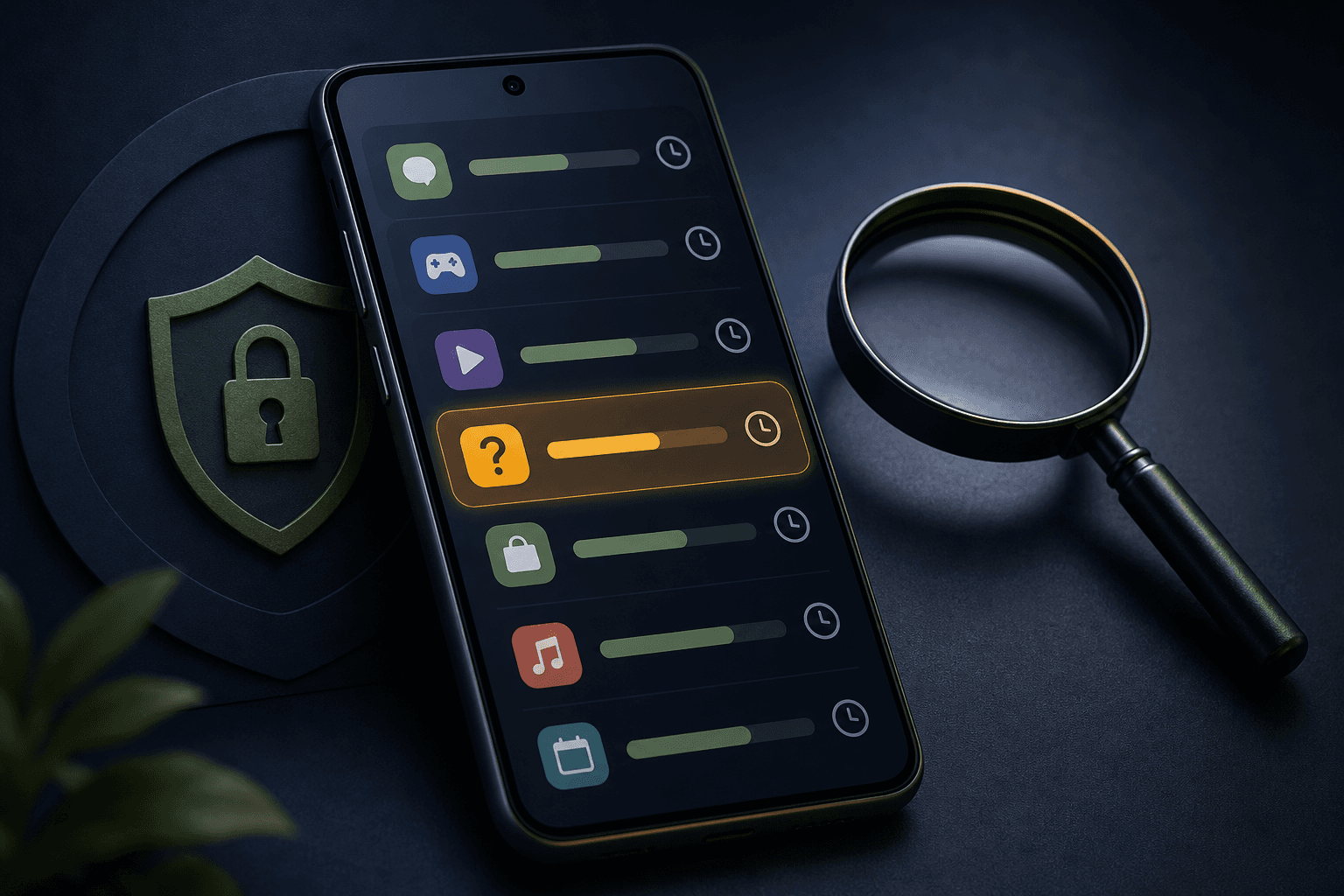
If an unfamiliar app appears near the top of your phone's usage list, that can be unsettling. The first thing to know is that high Android app usage is a clue about activity, not proof that someone is tracking you.
Android phones usually show this information through Digital Wellbeing, Screen time, or a similarly named settings area. Depending on your phone and Android version, you may be able to see how long an app was open, how often it was opened, and sometimes how many notifications it sent. These records help you ask better questions, but they do not identify every form of surveillance.
This guide explains where to look, how to interpret the results, and what to check next if an app or pattern seems unfamiliar.
What Android app usage records show#
App-usage records generally describe how you interact with apps on the device. Common measurements include:
- Screen time or the amount of time an app was visible and in use.
- The number of times an app was opened.
- Notifications sent by an app, where the device reports that information.
- Daily or weekly usage patterns.
- A list of apps ranked by time used or another activity measure.
The exact records vary. Some Android phones combine usage information under Digital Wellbeing; others use labels such as Screen time, App usage, or Device usage. Work profiles, parental controls, private spaces, battery-saving modes, and manufacturer software can also affect what appears.
An app can appear in a usage list for ordinary reasons. For example, a launcher, keyboard, accessibility tool, video player, navigation app, or communication app may be active frequently without being malicious.
How to check app usage on Android#
Menu names differ between manufacturers, but this is a useful starting point:
- Open Settings.
- Look for Digital Wellbeing & parental controls, Digital Wellbeing, Screen time, or App usage.
- Open the usage dashboard or chart.
- Select the day or time period you want to examine.
- Tap an app to see the details available on your phone.
If you cannot find the option, use the search field at the top of Settings and try Digital Wellbeing, screen time, or usage. Samsung and other Android manufacturers may place the feature under a different heading or present a different dashboard.
These instructions are general rather than a guarantee of a specific menu path. Android settings change across versions, manufacturers, regions, account configurations, and managed devices.
App usage is not the same as data usage or battery usage#
Several Android dashboards can look similar while measuring different things. Confusing them can lead to the wrong conclusion.
| Record | What it helps you understand | What it does not prove |
|---|---|---|
| App usage or screen time | How much an app was used or displayed | That the app is spyware or sending information |
| Mobile-data usage | How much cellular or Wi-Fi data an app consumed, depending on the dashboard | That the app was visible on screen or that the data was malicious |
| Battery usage | How much battery activity the system attributes to an app or service | That the app is monitoring you |
| Permissions | Which protected device features or information an app can request | That the app actually used every granted permission |
| Special access | Whether an app has higher-impact access, such as accessibility or notification access | That the app is necessarily unsafe |
For a separate investigation, you can review Android data usage and mobile-data consumption. Battery activity is a different signal again; checking Android battery usage can help identify power-related causes without confusing them with screen time.

How to interpret an unfamiliar app with high usage#
Start with the simplest explanation and work toward more detailed checks.
1. Confirm what the app is#
Tap the app entry, if possible, and check its name and icon. Then look for it in Settings > Apps or Apps & notifications. Review the developer, installation source, version, and whether it is a system component.
Some entries may represent Android services rather than apps you deliberately installed. A familiar app may also have a separate component for a work profile, wearable device, launcher, keyboard, or account service.
2. Compare the time pattern with your own activity#
Ask whether the record matches something you did. A video app used during a long viewing session, a map app used during travel, or a messaging app opened repeatedly may be completely expected.
Look for patterns rather than a single ranking:
- Does usage occur when you remember using the app?
- Is the activity limited to a normal period, or does it appear repeatedly at unusual times?
- Did the pattern begin after an update, reinstall, account change, or new accessory?
- Is the app still present and active, or is the record from an earlier period?
Usage history can be incomplete or affected by device settings, so treat it as an observation rather than a definitive timeline.
3. Check permissions and special access#
Usage becomes more meaningful when considered alongside permissions and access settings. Review whether the app has access to information or functions it reasonably needs.
For example, a flashlight app requesting contact access deserves a closer look, while a navigation app requesting location access has an obvious functional explanation. Neither example alone proves wrongdoing; the context matters.
You can use this site's guide to review Android app permissions for location, camera, and microphone access. If an app has accessibility access, notification access, device-administrator access, or permission to appear over other apps, investigate those settings carefully rather than relying only on screen-time information.
4. Check whether the app came from a trusted source#
An app installed through Google Play is not automatically harmless, and an app outside Google Play is not automatically malicious. However, an unexpected installation source is a reason to ask how the app arrived on the device.
Do not install an unknown APK merely to investigate it. Avoid disabling Google Play Protect or other built-in protections while troubleshooting.
When unusual usage justifies more investigation#
Consider a broader review when several independent signals appear together, such as:
- An unfamiliar app with permissions that do not match its stated purpose.
- Unexpected accessibility, notification, administrator, or overlay access.
- An app that you cannot identify or remove through normal settings.
- A usage pattern that conflicts with your own activity and persists over time.
- Account-security warnings, unexpected sign-ins, or changed settings.
Even then, these signs do not identify one specific cause. The issue could involve an unwanted app, a shared or managed device, an account problem, a configuration error, or ordinary software behavior.
For broader context, see the guide on how to check an Android phone for spyware safely. A detector or permission review cannot guarantee that every form of surveillance has been found.
Why app usage alone does not prove tracking#
Screen-time data tells you that Android recorded activity associated with an app. It does not establish:
- Who used the app.
- What information the app accessed.
- Whether information left the device.
- Whether another person controlled the account or phone.
- Whether the app was recording audio, video, or location.
- Whether the activity was caused by malware.
A background service may perform work without appearing as ordinary screen time, while a legitimate app may appear frequently because it supports another feature. Conversely, an app with little visible screen time could still have permissions or background behavior worth reviewing. That is why usage should be combined with permissions, special-access settings, account security, and the physical circumstances of the phone.
Preserve observations before removing an app#
If you are concerned about a potentially unwanted app, record what you see before changing the device:
- Write down the app name, developer, version, and approximate installation date if available.
- Note its permissions and special-access settings.
- Record the dates and times of unusual usage.
- Save screenshots if doing so is safe for you.
- Check whether the phone is managed by an employer, school, parent, or another organization.
- Consider whether changing or removing the app could alert someone who has access to the device.
If you believe another person may react dangerously to changes on your phone, prioritize personal safety. Use a safer device or seek help from a trusted professional or local support service before confronting anyone or removing software.
A practical Android usage checklist#
Use this sequence rather than jumping straight to a factory reset:
- Find the record: Open Digital Wellbeing, Screen time, or the equivalent usage dashboard.
- Identify the app: Check its listing in the Apps settings.
- Compare the timing: Match the activity with your own use and recent device changes.
- Separate the evidence: Check app usage, data usage, battery usage, permissions, and special access separately.
- Review accounts: Look for unexpected sign-ins, security alerts, or unfamiliar devices.
- Preserve notes: Record findings before uninstalling or resetting anything.
- Choose a proportionate response: Update, remove, restrict, secure accounts, or seek specialist help based on the evidence.
The key takeaway is simple: Android app usage can help you spot a pattern, but it cannot by itself tell you whether an app is tracking you. Use it as the first step in a careful, privacy-focused review.